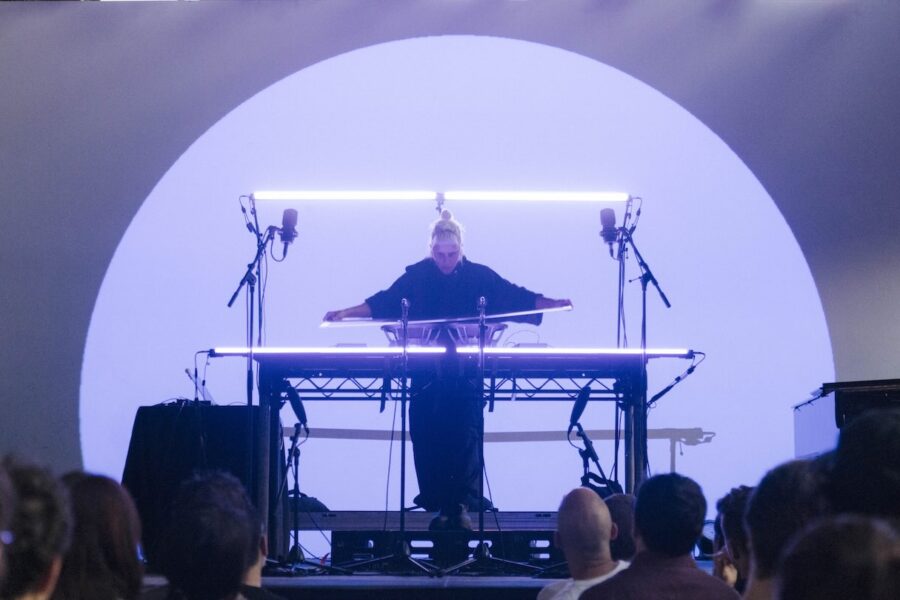

I hope I never forget the warm September night when I saw Kari Watson and Katinka Kleijn perform at Guild Row. I came for cutting-edge composition, but I walked away renewed. I hope I never forget what it felt like to be inexplicably and entirely seen by art.
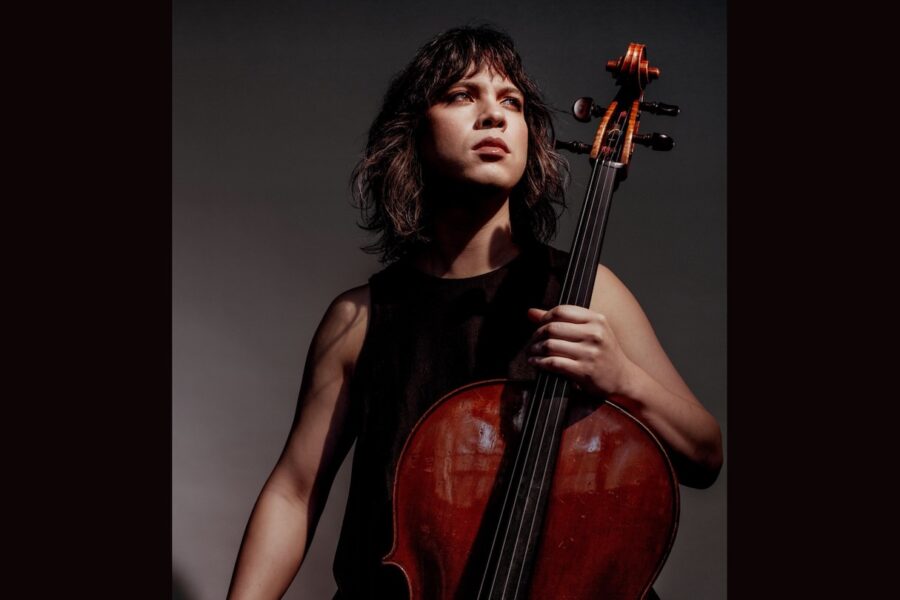
The beginning of their set snuck up on the audience. They emerged together from the back of the room, pushing through the morass of folding chairs, holding Korg Kaossilators in their hands. When they reached the stage, Kleijn mixed her cello smoothly into the sea of gurgling alien scratches, filling out the spectrum of sound. Her bowing steadily intensified as Watson kept the pressure cooker roiling with pulsating drones from their eurorack analog modular synthesizer.
The deep, low reverberations reminded me of the chop of helicopter blades. As soon as the thought crossed my mind, I realized what had me so forcibly riveted. The low cello pizzicato thrumming like an anxious heartbeat, the fleeting melodic lines coming up for air, the thick atmosphere of dread: this is what my inner and outer life sounded like during last fall’s Operation Midway Blitz.
When Border Patrol occupied the city of Chicago, my immigrant neighborhood was flooded by the sound of helicopters circling overhead. The ever-present fear in your ears, in your entire body, as you desperately try to salvage any kind of normalcy, any kind of peace: Kleijn and Watson made that feeling manifest. I have no evidence that this evocation was in any way their compositional intent. Still, I’m grateful for their unflinching exploration of this desolate, beautiful soundscape.

That performance was one of over 50 offerings at Sound and Gravity, Chicago’s newest avant-garde music festival, which returned for its second year from Sept. 3-6. This festival is the creation of local drummer and composer Mike Reed, who is known for co-founding the Pitchfork Music Festival (may it rest in peace). Reed also owns the experimental music venue Constellation, and Sound and Gravity serves as a fundraiser for the fiercely beloved hall.
For four late-summer nights, I criss-crossed Belmont Avenue over the Chicago River, savoring shows on seven different stages, including two at a whiskey distillery and one on an outdoor patio directly overlooking the river. The performances ran precisely to schedule. The rooms were full, but rarely overcrowded. Attendees compared the experience of Sound and Gravity favorably to Knoxville’s Big Ears Festival, praising Sound and Gravity as similarly well-curated but easier to navigate.
I sought out Chicago-based artists on my journey through Sound and Gravity, though the organizers did feature musicians from all across the country (and even across the pond.) Watson was one of several artists I saw hunched over their laptops throughout the weekend. In 2026, we’re all considering the relationship between humans, technology, and art, and a festival like Sound and Gravity, which prominently features so many electronic acts, forces such questions to the fore.
Some artists positioned themselves firmly on one side of the technological debate: during their cumbia-infused set on Thursday night, the Chicago-based Dos Santos Quintet whooped, “Live music everybody! This isn’t fucking AI!” But others chose to situate themselves within the continually evolving lineage of electroacoustic experimentation. Watson and Kleijn braided modular synthesizer and cello together beautifully; each felt like a natural extension of the other’s sonic range. Watson and Kleijn traded glances and played off each other throughout their set; it was easy to follow the flow of human connection and energy.

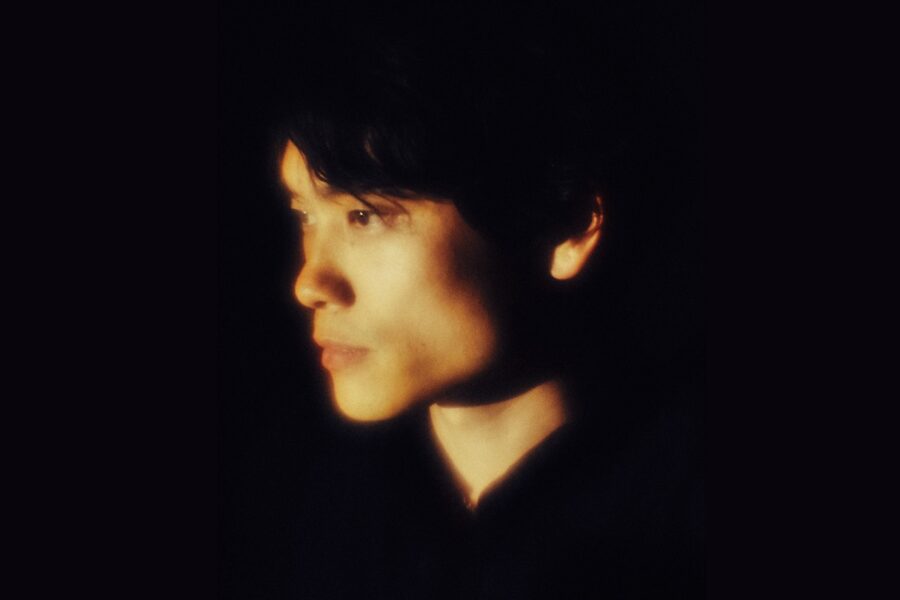
Tyondai Braxton’s performance, on the other hand, felt deeply impersonal. It was certainly mesmerizing: the impenetrable darkness of Beat Kitchen’s floor, Braxton faintly aglow, hair wild, cloaked in black. But as a listener, it seemed like Braxton’s world had narrowed to just himself and his machinery, and the audience’s presence was all but irrelevant. Braxton’s hour featured harsh synthetic tonalities comparable to Kleijn and Watson’s, but I struggled to find a similar emotional toehold in his sonic landscape.
Like Braxton, Ana Roxanne kept the audience at arm’s length. With only her side profile visible as she sang towards her laptop, her Friday night set at Constellation could easily have felt too mechanistic. But instead, her performance felt as warm and glowing as the paper lanterns swaying above. The addition of judicious loops and drones only served to amplify the naturalistic, windlike timbre of her voice.
You’d have to work to dislike Roxanne’s performance, given the incredible radiance of her sound. Still, she offered a challenge to the audience by consistently deploying unsettlingly slow tempos. In a sort of backlash to modern life, she forced the audience to stay engaged without clear rhythmic drive: a provocation to the room, daring us to unshatter our attention spans.
Roxanne has spent significant time studying the techniques of North Indian Hindustani vocalists. She integrated these stylizations into her music subtly, capturing the shimmering quality of Hindustani melismas and using them to amplify the luminescence of her voice. This felt like cultural exchange at its best; not appropriative, but well-considered and additive.

This enchanting and thoughtful offering stood in stark contrast to the performance I’d seen earlier that night. Natural Information Society and Bitchin’ Bajas took the stage together at Rockwell on the River, two Chicago institutions fusing their sounds together. Their cohesive and compelling collaboration demonstrated an impressive ability to bring the crowd along as they transitioned through vastly different musical geographies with fluidity. But despite how skillfully they executed their project, I felt alienated by its conceit.
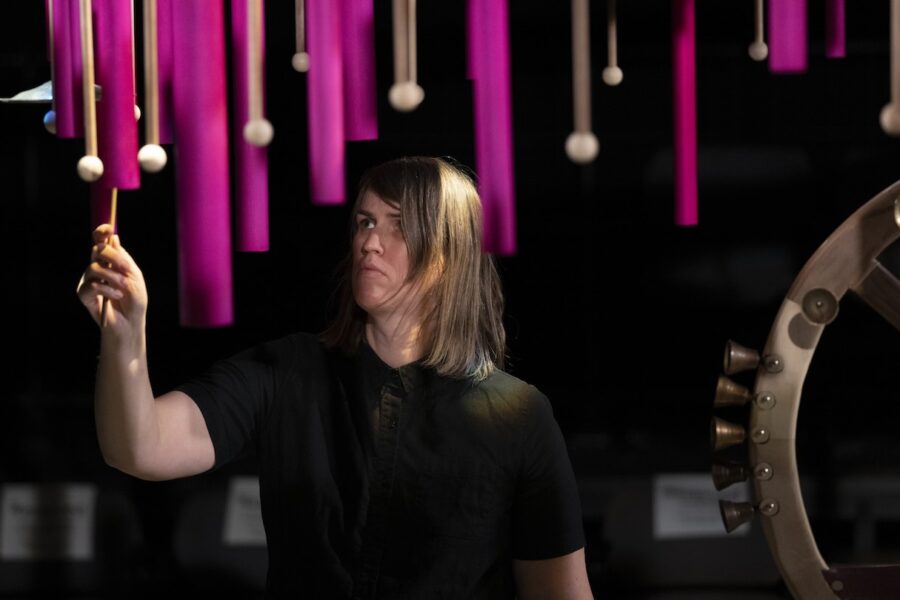
Their opening soundscape was clearly intended to conjure ‘Eastern’ imagery. Shimmering cloudlike sounds from soft mallets on suspended cymbals, jangling Buddhist brass bell bracelets, droning harmonium underneath: these created a vivid, mystical effect. I saw several audience members with transcendent, transported looks on their faces. But I felt strange. To me, the music seemed obviously rooted in a 1960s American fantasy of the ‘Orient.’ In 2026, the performance did not feel like the result of generative musical cross-pollination. It made me feel othered.
Still, I spoke with several attendees who told me that Natural Information Society and Bitchin’ Bajas’ performance was the highlight of their time at Sound and Gravity. My anomalous reaction made sense considering the festival’s demographics. I’m a small South Asian-American woman, and at Sound and Gravity, I stood out. Over the course of the weekend, I saw nine different shows across seven different venues, featuring white, Black, Asian, and Latino artists, but the crowd in every room, without fail, was overwhelmingly white and male.
Chicago has a problem with segregation. Some of Sound and Gravity’s homogeneity was a function of its location on the North Side in the Avondale neighborhood. Still, Avondale has a significant Hispanic population. And more generally, when I think of the history of new American music, I think of the innovations and daring of marginalized peoples. I was disappointed not to see more women and people of color in the audience, especially since the festival wasn’t inherently inaccessible. In future years, the festival can and should build on its strengths, such as its affordable ticket prices, to bring in new attendees.

The Tomeka Reid Quartet attracted a slightly more diverse crowd than the festival at large. Reid is a cellist and a highly decorated pillar of the Chicago free jazz scene. On Saturday night, she headed up a vigorous, lively performance alongside guitarist Mary Halvorson, double bassist Jason Roebke, and drummer Tomas Fujiwara. Then, on Sunday, she appeared as part of Fujiwara’s own 7 Poets Trio in a warm and whirling performance featuring vibraphonist Jason Adasiewicz.
I was struck by Reid’s command of timbre and color. My view of the stage was obscured during the quartet’s performance on Saturday night; the room at Judson & Moore was packed! At one point, I wondered: where is that brassy sound coming from? Oh: it was still Reid’s cello! In her hands, the cello is an entire swing band.
Both the Tomeka Reid Quartet and the 7 Poets Trio performed composed music but maintained a sense of play, improvisation, and freedom. Overall, Sound and Gravity did an excellent job of elevating ‘serious’ music while still holding space for whimsy. Guitarist Gregory Uhlmann’s Extra Stars trio with Booker Stardrum on percussion and Will Miller on EVI was chirpy, bouncy, and bright. Listening to them, I felt effervescent, young, and motivated to dig up my 8th-grade kalimba. I also enjoyed the shimmering, starlike ambiance of Ami Dang’s performance. The Sikh-American synth and sitar artist from Baltimore invited the audience to vocalize along with her on her last song, reminding us that the best art is the art we make together.
Sound and Gravity was a worthwhile, ebullient musical adventure. I relished hearing diverse artists experiment with instrumentation, genre, and form, but there were at least 40 sets I didn’t get to see, so many sounds I didn’t get to savor. Future editions of Sound and Gravity will reel me back in, eager to hear what I missed. When I do return, I hope it will be alongside more Chicagoans from every walk of life.
I CARE IF YOU LISTEN is an editorially-independent program of the American Composers Forum, and is made possible thanks to generous donor and institutional support. You can support the work of ICIYL with a tax-deductible gift to ACF. For more on ACF, visit composersforum.org.
The American Composers Forum (ACF) is thrilled to announce that Recomposing America is officially ou...
Tags
Recomposing America
For musicians seeking to collaborate outside of the neatly delineated roles of “composer” and “perfo...
Tags
Anna Thorvaldsdottir, Annea Lockwood, Claire Chase, Cory Smythe, Dai Fujikura, Edgard Varèse, Felipe Lara, George Lewis, JACK Quartet, Katinka Kleijn, Levy Lorenzo, Liza Lim, Marcos Balter, Matana Roberts, Nate Wooley, Seth Parker Woods, Susie Ibarra, Terry Riley, Tyshawn Sorey
Katherine Young’s immersive practice is rooted in the art of collection: her work searches for sound...
Tags
Ben LaMar Gay, Chaikin Records, Katherine Young, Linda Jankowska, Mattie Barbier, Olivia Block, RAGE THORMBONES, wasteLand, Weston Olencki, Yarn/Wire
Molly Joyce is a composer and performer whose work explores disability as a creative source. Describ...
Tags
Adrian Anantawan, Drake Music, Gaelynn Lea, Imogen Heap, Jimi Hendrix, John Kelly, Laetitia Sonami, Lee Abramson, Michel Waisvisz, Molly Joyce, The Jimi Hendrix Experience
Christian Li is a pianist, composer, and arranger based in New York City whose work spans a wide ran...
Tags
Asher Kurtz, Christian Li, Endectomorph Music, JP Bouvet
On their new album Generate Music (XAS Records), PRISM radically reimagines the saxophone quartet as...
Tags
David Krakauer, Diane Monroe, Erika Hunt, Fred Wesley, Helen Haynes, Matthew Levy, Myra Melford, PRISM Quartet, Susan Watts, Tyshawn Sorey, Ursula Rucker, Yotam Haber
What happens when an iconoclast becomes an institution? That question continues to unfold with Juliu...
Tags
AfriClassical Futures, Ahmed Al Abaca, Alex Moore, Elastic Arts, Epiphany Center for the Arts, Evé Sanchez, Florence Price, Julian Otis, King Sophia, Lindsey Sharpe, Luis González, Malik Johnson, Nick Reeves, olula negre, Ómkara Gil, Peter Maxwell Davies, Sajdah Muhammad
The sky can’t decide if it’s going to rain. Baby blue dots the gaps between hulking grey clouds over...
Tags
Alissa Ona Jacobsen, Dameun Strange, Edna's Park, Liz Draper, Mikey Marget
The organ at the Church of St. Luke & St. Matthew looms over Sarah Davachi as she takes a seat t...
Tags
EMPAC, Late Music, Sarah Davachi
In the last minutes of Márton Illés’ Forajzok (2021), every member of the International Contemporary...
Tags
Farzia Fallah, Imsu Choi, International Contemporary Ensemble, Márton Illés, Njabulo Phungula, Rebekah Heller, The DiMenna Center for Classical Music, TIME:SPANS festival
The work of Mary Kouyoumdjian is equally rooted in composition and documentary through projects abou...
Tags
Alarm Will Sound, Cantaloupe Music, Mary Kouyoumdjian, Nigel Maister
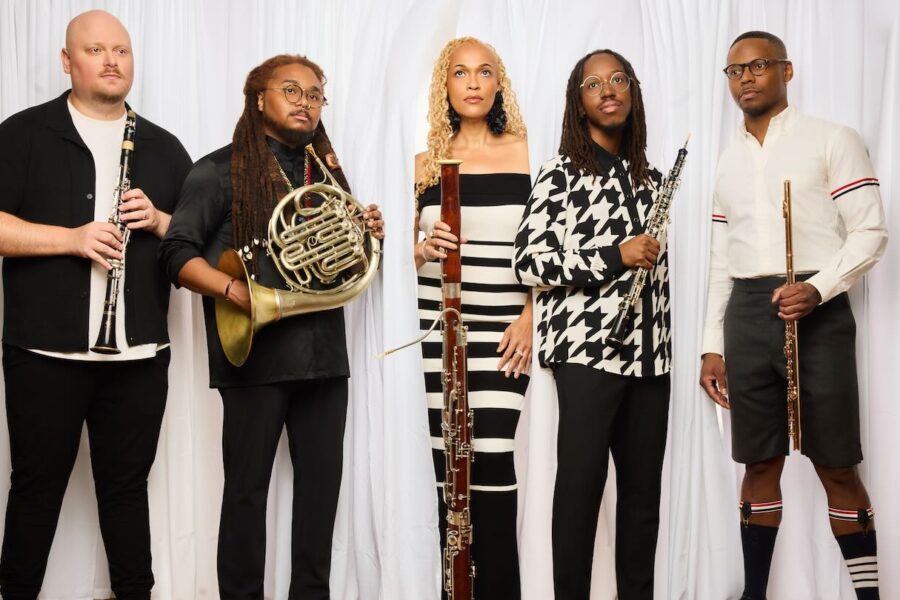
Imani Winds is an ensemble that has continually fulfilled its mission to inspire generations of musi...
Tags
Billy Taylor, Dick Dallas, Donny Hathaway, Imani Winds, Imani Winds Media, Jeff Scott, Kevin Newton, Mariam Adam, Mark Dover, Mekhi Gladden, Monica Ellis, Nina Simone, Pavel Haas, Shawn Okpebholo, Stevie Wonder, Toyin Spellman-Diaz, Valerie Coleman
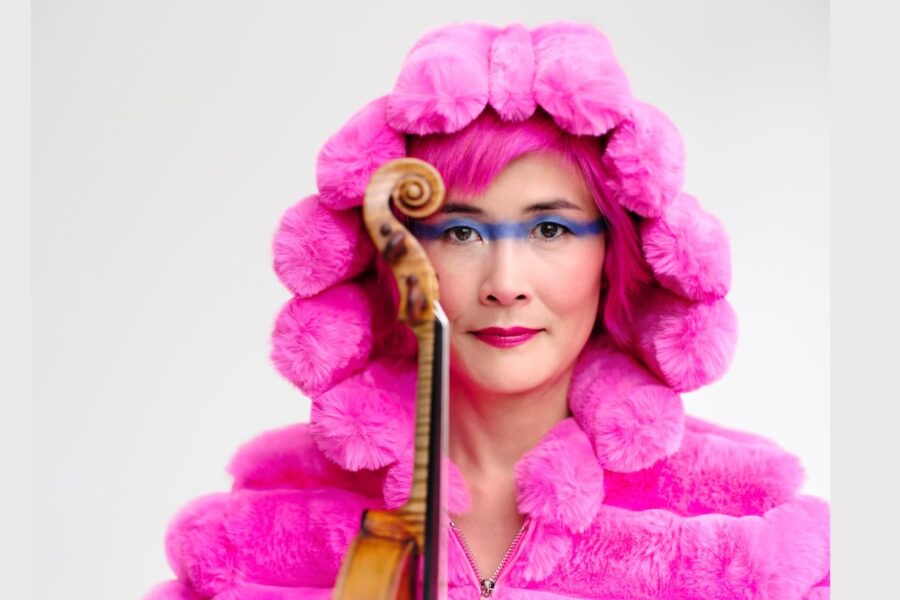
On The American Concerto, Volume One (Aug. 14, Cedille Records), the Grammy Award-winning violinist...
Tags
Cedille Records, Courtney Bryan, Jennifer Koh, Oberlin Contemporary Music Ensemble, Timothy Weiss, Vijay Iyer
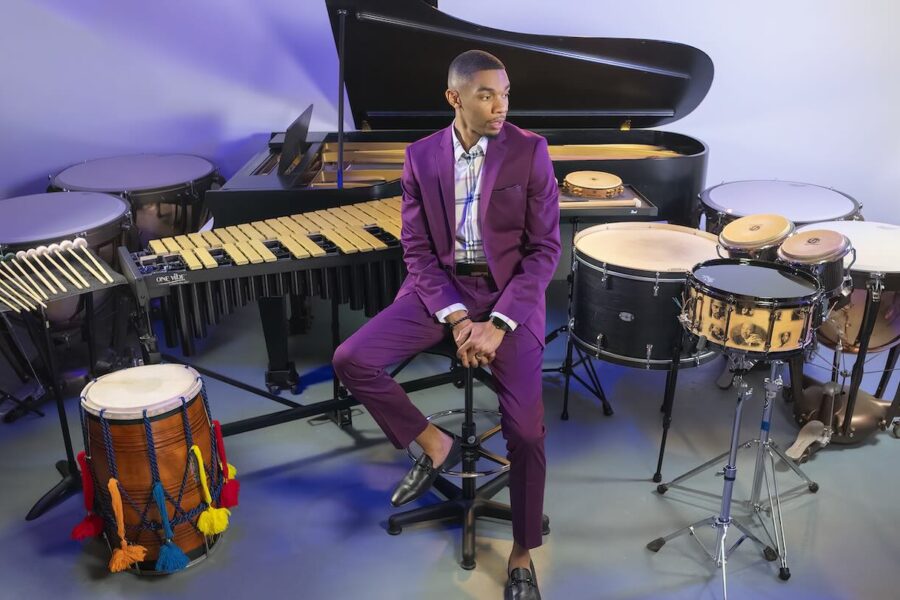
Composer and percussionist Christopher Thompson deftly demonstrates how overlooking the constraints...
Tags
Christopher Thompson, Emerging Black Composers Project, Michael Morgan Prize, San Francisco Symphony
Rebekah Heller is on a mission to smash every tired stereotype or bad orchestra joke about the basso...
Tags
Brittany J. Green, Cantaloupe Music, Fay Victor, Jessie Cox, Julius Eastman, Rebekah Heller, Steve Reich
Applications for our 2027 McKnight Composer Fellowships are now open. These awards are presented in...
Tags
American Composers Forum, McKnight Artist and Culture Bearer Fellowship Program, McKnight Composer Fellowships, McKnight Foundation, Recomposing America
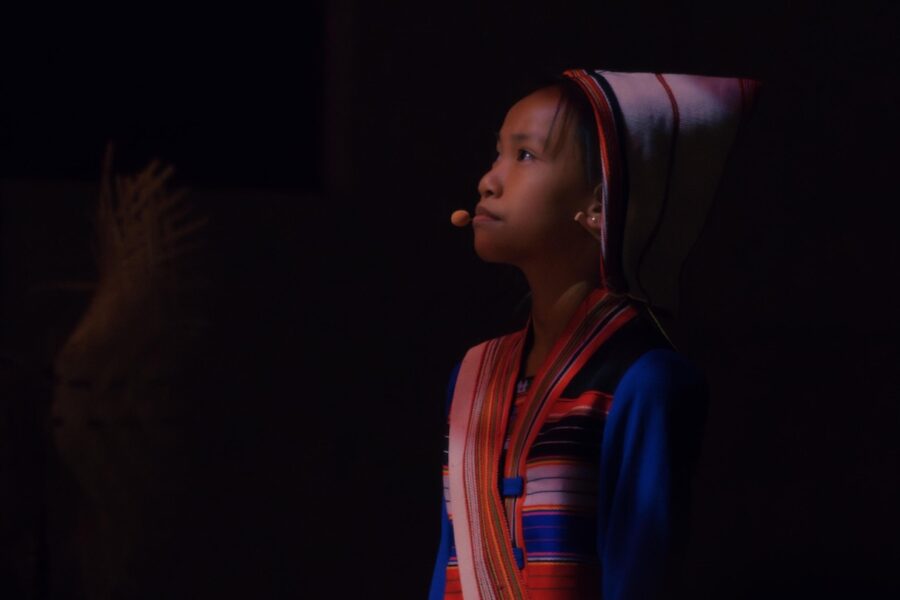
A last-minute venue change brought Chinese Arts Week’s presentation of Du Yun’s The Ocean Etched in...
Tags
Du Yun, He Guiying, Lincoln Center, OK MISS, Piao Niu
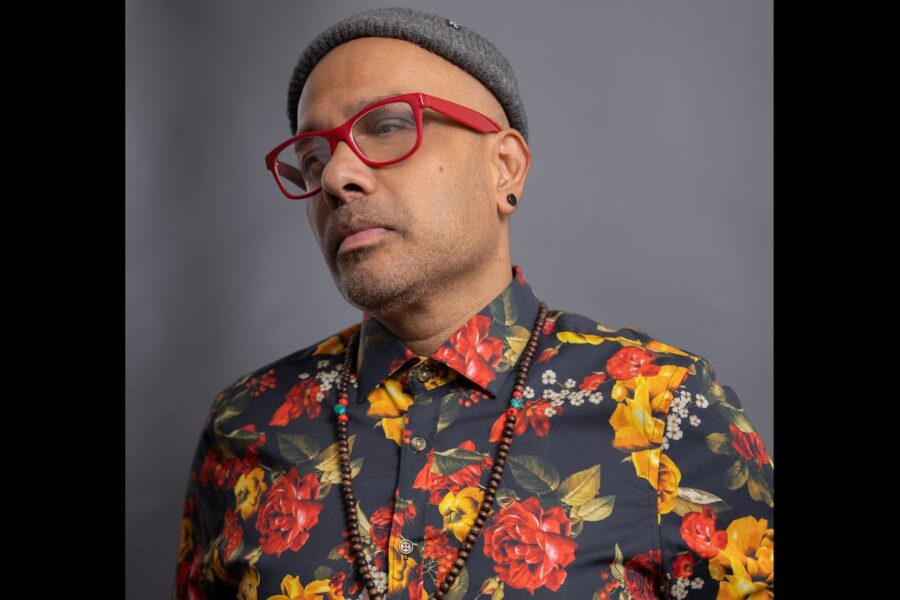
Electronic drummer, producer, educator, and clinician Ravish Momin is known for his groundbreaking r...
Tags
'Kuza, 3Phaz, Abdullah Miniawy, Abu Ama, Deena Abdelwahed, Devi Mambouka, DJ Lag, Dolphins of Venice, El Kontessa, Kibrom Birhane, Kush Arora, Lila Tirando a Violeta, Mahorka, Masma Dream World, Moki McFly, New Music USA Creator Fund, Nihiloxica, Nkululeko Zungu, Nyege Nyege Tapes, Rani Jambak, Ravish Momin, Saba Alizadeh, Saskia, Sunken Cages, Tanya Tagaq, Trio Tarana, Turning Jewels into Water, Val Jeanty, Weldroid
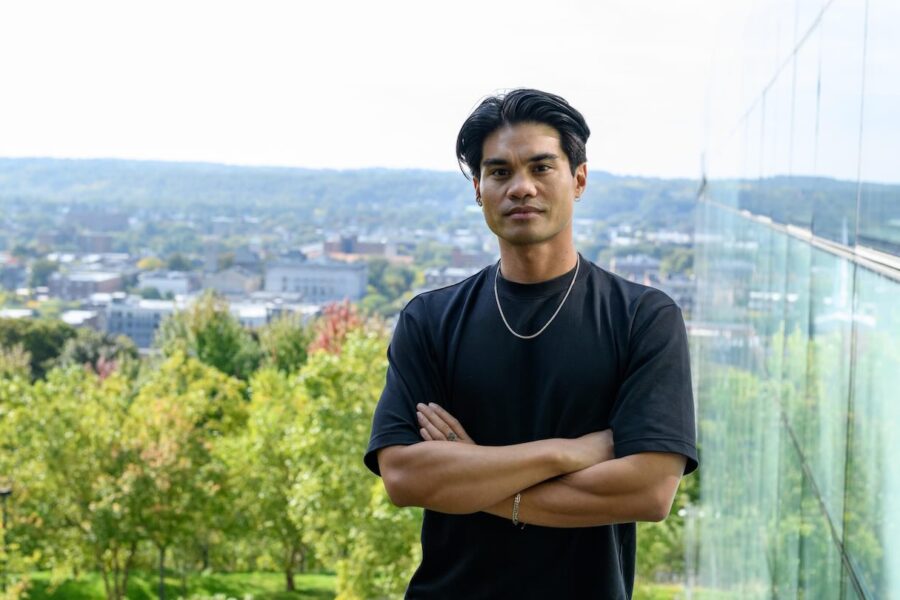
The work of Amadeus Julian Regucera (b.1984, He/They) engages with the embodied and acoustical energ...
Tags
[Ahmed], Amadeus Julian Regucera, Amadeus Regucera, Charles Curtis, Charmaine Lee, Elaine Mitchener, Éliane Radigue, EMPAC, Eva Furrer, Gaber Modus Operandi, Georges Aperghis, HULUBALANG, Johanne Saunier, Kasimyn, Miho Hatori, Mike Schmidt, Richard Dubelsky, Sarah Davachi
Over the past 20 years, Sarah Hennies has developed an iterative musical practice that finds sonic a...
Tags
[Switch~Ensemble], Alex Matterson, Andrew Yee, Bent Duo, Cabrillo Festival, EMPAC, GLISS Residency, Greg Stuart, Hazel Foxræ, inti figgis-vizueta, Joe Houston, Judith Hamann, Lulu West, Nate Wooley, Sarah Hennies, Sarah Saviet, Stuart Saunders Smith, Tristan Kasten-Krause
Andrew Yee, a multi-hyphenate new music powerhouse, continues to build an oeuvre that spans composit...
Tags
Andrew Yee, Attacca Quartet, Caroline Shaw, New Amsterdam Records, NOVUS NY, Trinity Choir
Dylan Fujioka is a Japanese-American composer, performer, actor, and model most known for his work o...
Tags
Akira Ifukube, Bad Brains, Dylan Fujioka, Jeanette, Juan Gabriel, Ocrilim, Ornette Coleman, Selena, Siouxsie And The Banshees, The Peanuts
It’s end-of-term showtime at the London conservatoires, and recently I’ve seen some exciting new sho...
Tags
Alex Hardy, Anastasia Koorn, Asher Joyce, Bella Marslen, Charlotte Jane Kennedy, Daniel Musashi, David Fraser, Deniz Dortok, Eden Shifroni, Lasha Kharkhelauri, Michael Rosewell, Royal College of Music, Ruvin Meda, Taining Zhao, Tète-à-Tète, Tom Law