
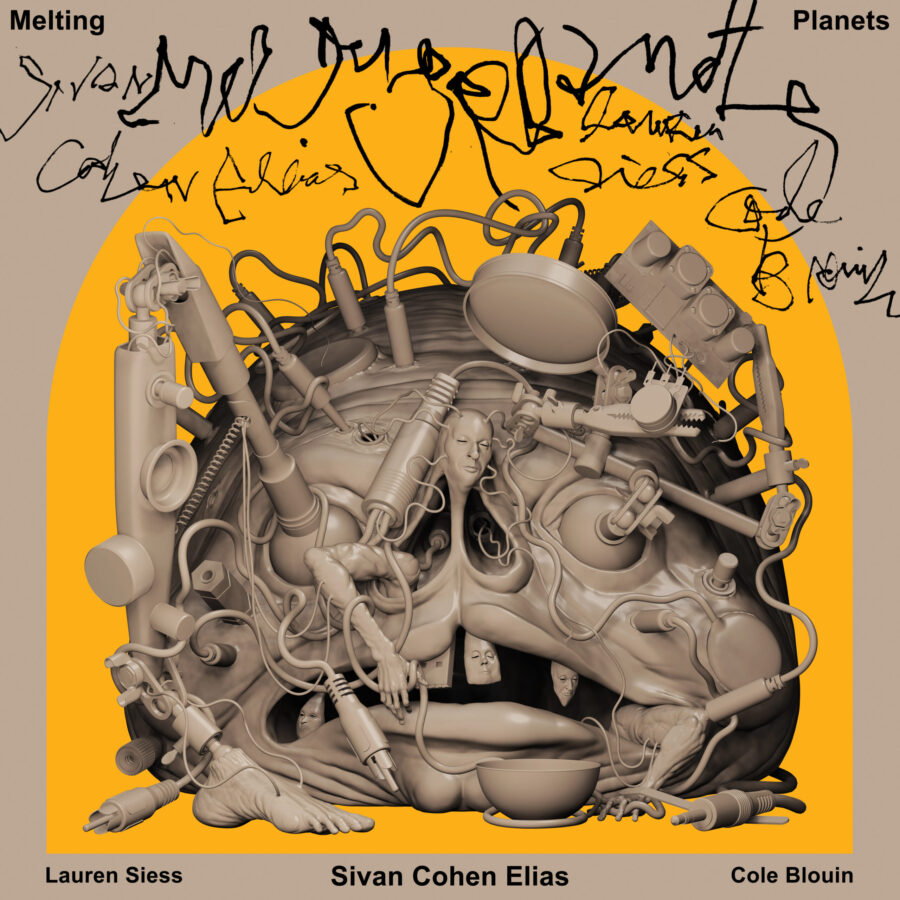
At once vast and intimate, Melting Planets draws the listener into an immersive soundworld where nature behaves in unexpected ways: drops of rain might sound like a fusion of glassy, metal, wooden, plastic, and electric pops, while gravity shifts in multiple directions, causing bursts of sound to appear, vanish, and continuously descend into the unknown.
The album is the result of two years of musical and extramusical dialogue between three composers/improvisers – Sivan Cohen Elias (sound instruments/ objects, voice, live electronics), Lauren Siess (viola, objects, no-input mixer), and Cole Blouin (electric guitar, objects). Their collaboration culminated in this recording, artistically directed and produced by Sivan Cohen Elias.
The album embraces dynamic, visceral music, conceptualized as musical “scenes” set in fictional worlds undergoing surreal ecological collapse. Within these apocalyptic environments, new hybrid lifeforms begin to emerge. The trio imagined what might survive in an environment defined by constant, extreme transformations – shifting from extreme heat to deep freezes, from dryness to overwhelming humidity. They explored the evolution of a new physics and the struggles for survival that might emerge in such a world. What kinds of creatures would exist? They pictured hybrids of disproportionate, absurd body parts, and speculated on those creatures’ behaviors and interactions. In so doing, the trio discovered the absurdity of this world – its pain, its humor, its complexity, its hope, and its cycles.
On the sonic level, the album presents an intricate, electronic-heavy sound-world that deliberately defies genre classification. The imagery emerged through an ongoing dialogue with their collection of instruments and sound-making devices, which were blended in real-time using digital sound processing. The trio fused elements of classical, multicultural, and electronic instruments with unconventional objects (a complete list is below), while the live electronic manipulations transformed them into immersive, experiential sounds – inviting the listener to perceive the sound itself almost as a physical body, ensuring that the sound had the feeling of melting. One section of the album focuses on a drowning creature – a three-track piece that demands active listening, such that the listener can fully experience the creature’s voice, actions, emotions, and surroundings. It begins with a kazoo and viola mirroring each other in long, bending tones, recalling a desperate cry. Meanwhile, birdlike sounds emerge from electronic manipulations of a bowed fishing line tied around the guitar strings. As the piece unfolds, bubbling water and thick mud are sonically conjured through vibrating devices and a no-input mixer, gradually transforming into a soundscape of melting and drowning. The section culminates in a visceral, choral-like tutti performed on flute piccolo, bowed electric guitar, and viola.
The trio began improvising together in late 2021. In the summer of 2022, just before Siess left for composition studies in Dresden, Germany, and Cohen Elias departed for a teaching position at the University of Minnesota, they decided to record an album. From that session, one track stood out—Scoby Song—the only piece from that recording to make it onto the album. Its name reflects its role as a foundational element, a kind of starter culture for the material they continued to develop remotely over the following year. Throughout discussions, the trio kept returning to ideas of sonic walls, fermentation, unknown cultural sound, and the concept of sound melting. The long, frozen chord at the end of Scoby Song, along with the use of the kazoo and saxophone mouthpiece as tools for personification, became central motifs that evolved further as they worked towards the second recording session.
In the summer of 2023, the trio members reunited in NYC and rehearsed at Studio Fog Expanse, Cole’s recording and production space in Ridgewood, Queens, where they continued developing sonic “scenes” by forming a sequence of specified actions and reflected images while improvising the details, nuances, and musical flow. Over two intense days at Greyfade Studio, in Mount Vernon, New York, they recorded multiple takes of those scenes, along with free improvisations working in the same sonic atmospheres, and techniques. This session generated a wealth of material, which Cohen Elias later sorted, selected, and edited. Working with the phenomenal engineer Joseph Branciforte during postproduction – recording, mixing, and mastering – brought the album to life with the exact crispness, clarity, and immersive quality Cohen Elias had envisioned.
Ochin Pakhi, a Chicago band devoted to traditional Bengali music, is proud to announce the release of their album Praner Alap: Meeting of Hearts on Innova Recordings. An ambitious artistic collaboration, the album features new musical arrangements of songs by poet Rabindranath Tagore from his Nobel Prize-winning poetry collection Gitanjali (Song Offerings).
With soaring vocals by Subhajit Sengupta and Swarnali Banerjee intertwined with sweeping strings, accordion, raga-based improvisations, and a myriad of instruments, Praner Alap brings new emotional intensity to Tagore’s melodies and lyrics. The digital album is complemented by a poetry and art booklet featuring paintings inspired by each song, painted by a variety of artists, and newly translated lyrics.
“Praner Alap is the culmination of a beautiful collaboration between dear friends from around the world who joined their diverse artistic backgrounds to explore the depth of Tagore’s songs,” said Lucia Thomas, the band member who translated the lyrics, and who performs on violin and Bengali folk instruments. “We hope this album will introduce listeners to the incredible power of Tagore’s words and melodies.”
Published in 1910, Gitanjali was Tagore’s groundbreaking collection of Bengali poetry that largely contained lyrics of songs he had composed. Tagore’s English translation of Gitanjali gained popularity in the West and won him a Nobel Prize in Literature in 1913, but the melodies of the songs remained unknown to Western audiences. Praner Alap brings these musical works to life for contemporary listeners through innovative cross-cultural arrangements.
Ochin Pakhi has been performing Bengali music in Chicago since 2017. In addition to Tagore’s songs, the band’s repertoire includes songs of the Bauls, mystic minstrels of Bengal. The group is featured in an award-winning documentary titled “Ochin Pakhi” by director Elja Roy. Praner Alap, the group’s first album, was produced by Chicago Folklore Ensemble, a group established in 2015 to celebrate immigrant communities through interdisciplinary performances interweaving music and storytelling.

Africa in New Orleans is a collection of songs created from the wellspring of collaboration that is composer, musician and dancer, Sidiki Conde. In 2023, The New Orleans Jazz National Historical Park invited Conde and guitarist, Wowo Souakoli, to work with New Orleans musicians engaged in the diverse genres of the city: jazz, blues, and zydeco. All genres with origins in West Africa where Conde hails from. Through this collaboration Conde felt both at home and part of a bigger global story.
Africa in New Orleans is a collection of songs created from the wellspring of collaboration that is composer, musician and dancer, Sidiki Conde. In 2023, The New Orleans Jazz National Historical Park invited Conde and guitarist, Wowo Souakoli, to work with New Orleans musicians engaged in the diverse genres of the city: jazz, blues, and zydeco. All genres with origins in West Africa where Conde hails from. Through this collaboration Conde felt both at home and part of a bigger global story.
Neera does not tell one single story; it tells multiple, entwining stories through its sounds. One thread is joy, creativity, and freedom in art. The different sonic combinations—created with violin, viola, kamancheh, tombak, spoken word, electronic pulses, and all the different timbres of each—show how the artists resist the restraints of being put in a box, labeled as a “violinist,” “classical musician,” or perhaps “Iranian immigrant.” Sarvin Hazin & Kimia Hesabi, like all of us, have a palette of experiences at their disposal, and they have used the full range in creating their debut album.
The inspiration from their identities is another thread; the music pulls from multiple traditions, inviting us to do the same. One story told is the strength and power of women throughout history. The piece titles give some clues, as they draw on Persian culture and obliquely allude to both ancient figures and more current women whose actions and values have become touchstones for Hazin & Hesabi, Persian culture, and sometimes throughout the world. The stories of each of these women—like the stories of all of us—are not isolated, but instead pull on the stories that came before, showing the connections across time, people, and cultures. The music itself is not specifically programmatic, but the grief and pain, harmoniously present with the meditative strength of those who persevere, spark change, and fight for true beauty is a theme throughout.
Neera is a multimedia project that blends various cultures and musical echo-systems. Derived from older Persian languages, Neera means “to shine light,” and they (or Hesabi and Hazin) took this meaning to heart by paying homage to Iranian women from different generations who were authentically and courageously themselves while living in a society that constantly worked to define them by enforcing its standards on their lives and identities.
Using Western classical instruments such as violin and viola, as well as Iranian classical instruments such as kamancheh and tombak, in combination with electronic sounds and vocals, give Neera a genre bending quality, and a unique and personal musical language and style.
Neera is a recipient of the Creator Development Fund from New Music USA in 2022.

Equal parts surreal and fantastic, Goldfeather’s new album, Change, leaps forward into a dynamic and effervescent sound world. Texturally dense and poetically resonant, the closest comparison could be if Laurie Anderson decided to make a Hyperpop album. The record ricochets between harsh, in-your-face electronics to beautifully rich orchestration, relaying a deeply visceral story along the way. Each song has a catchy melody that is underscored by unusual vocal and electronic effects and unpredictable key and time signature changes.
Change is an album that tells the story of volatile emotions, loss, and growth within an unraveling relationship. It boomerangs from feelings ranging from insecurity, helplessness, despair, anxiety, rage, remorse, and at the end, the painfully ecstatic joy of a protagonist who has faced her demons and rooted herself in resilience.
Goldfeather is an experimental pop band based out of New York City. The whimsical brainchild of Sarah Goldfeather and Mike Tierney, Goldfeather’s music has been described as “a nightmare funhouse-mirror take on Carly Rae Jepson-style upbeat pop [that is] deeply disconcerting and outrageously fun” (National Sawdust Log), “full of light and life” (The Current, Minnesota Public Radio), and “poignant…striking and laudable” (The Deli Magazine). Sarah and Mike have led rich and eclectic musical careers that inform their music. Sarah is currently the violinist for Lincoln Center Theater’s Production of Coastal Starlight and was the 2019-2020 violin chair for Tony-winning and Grammy-nominated Broadway production of Oklahoma!. She has made television appearances including The Tonight Show, The Today Show, The 2019 Tony Awards, has been a featured artist in series across the US and Europe, including TEDxMET, and has performed with notable artists such as Courtney Love, Lizzo, Ronnie Spector, and Kimbra. She is the artistic director of the ensemble Exceptet and a composer of chamber works commissioned by ETHEL quartet, Contemporaneous, pianist Timo Andres, and more. Mike is a three-time Grammy-nominated audio engineer and producer based in Brooklyn who has worked with a range of artists across genres, including Steve Reich, Medeski Martin & Wood; Stephen Stills; Julia Wolfe; Pharaoh Sanders; Judy Collins; and Alarm Will Sound. He currently works out of his studio, Shiny Things Studio.
Consolation is a song cycle composed by Samn Johnson for vocalist Tis Kaoru Zamler-Carhart, setting Latin poetry from Boethius’s Consolation of Philosophy. It features layers of Tis’s voice accompanied by Samn’s electronics and instrumental recordings.
Boethius wrote the Consolation in 524 AD while awaiting execution after his political downfall. He is visited in prison by the feminine allegorical character of Philosophy. Through their imagined dialogue, it is apparent that both characters are in fact himself, both male and female, both free and captive, facing his own questions about his life choices: money, fame, power—did they make him happy?
Consolation—the album—has been described by composer and music critic Alex Temple as “wildly polystylistic,” but the same can perhaps be said of Boethius’s original. Its mix of poetry and prose carried ancient readers along in the visceral flow of Latin meter, careening between intellectual elegance and sheer terror. Samn’s music hews closely to the maelstrom of Boethius’s emotions, but renders it with different devices. Tis’s voice, the backbone of the album, is pushed to virtuosic limits of range and timbre, spanning over four octaves with an astonishing array of colors and tuning systems. Interviewed by WMBR radio about Samn’s writing for the trans nonbinary voice, Tis says:
Around Tis’s voice, Samn’s electronic orchestra deploys echoes of Renaissance polyphony alongside 808 kick drums and synthesizers, flashes of romanticism, and washes of ambience. Early tuning systems—from Just Intonation to Meantone temperaments—are omnipresent in Samn’s music. For Boethius, who was also a music theorist, these would have not only been shimmering worlds of musical color, but allegories for how the cosmos is ordered. Perhaps the same is ultimately true for Samn, and is part of what binds him to Boethius across the centuries.
Describing this connection, Samn says, “When I first read the Consolation, it immediately drew me in. The practical philosophy felt so accessible, and the huge range of emotion and poetic rhythm was an exciting challenge to adapt. I knew this would push me to draw on a similar range of musical styles, and writing for Tis, whose voice transcends the gendered categories of classical vocal music, felt perfectly aligned with this aim. It’s also a vehicle to explore my religious and spiritual thoughts. We know from other sources that Boethius was a Christian, yet he does not evoke explicitly Christian concepts in his Consolation, instead describing God in the terms of neoplatonic philosophy. Whatever his intent may have been, I find this lack of doctrine to impart an appealing universality to his message, and is part of what makes me want to adapt it for the world I live in. In this text, written from prison, I find something transcendent and liberatory.”
Samn Johnson(he/they) is a composer, producer, and historical linguist. Their work often harnesses research on acoustics and historical phonology to set texts in ancient languages like Latin, Old English, Hittite, and Gothic. Samn has written for a range of performers including Chromic Duo, Righteous GIRLS, and harpsichordist Nathan Mondry. His latest two recordings, both self-released, are Ageless Sea (2022), for chamber choir, chamber orchestra, electronics, and rock band, and First Book for Piano (2022), performing his own piano works. Samn is also half of the synth pop duo Acraea, together with Leora Mandel. He holds degrees in composition from the University of Michigan and NYU, and has taken courses in Indo-European historical linguistics at the University of Leiden in the Netherlands. Samn lives in Kalamazoo, Michigan, where this album was recorded. (www.samnjohnsonmusic.com</…)
Tis Kaoru Zamler-Carhart (they/them) is a singer, composer, writer, designer, visual artist, and medievalist. Tis regularly works with composers who write specifically for their voice. Tis’s own composition output includes opera, chamber. and vocal music, and has been performed around the world. Tis’s books are published by Punctum Books and revolve around Africa, Byzantium, and the fragile boundaries of seriousness (Vitaly Zamler, is on display in New York and Brussels, and has been exhibited across Africa and Europe (The Royal Conservatoire in The Hague and Parsons School of Design in New York.
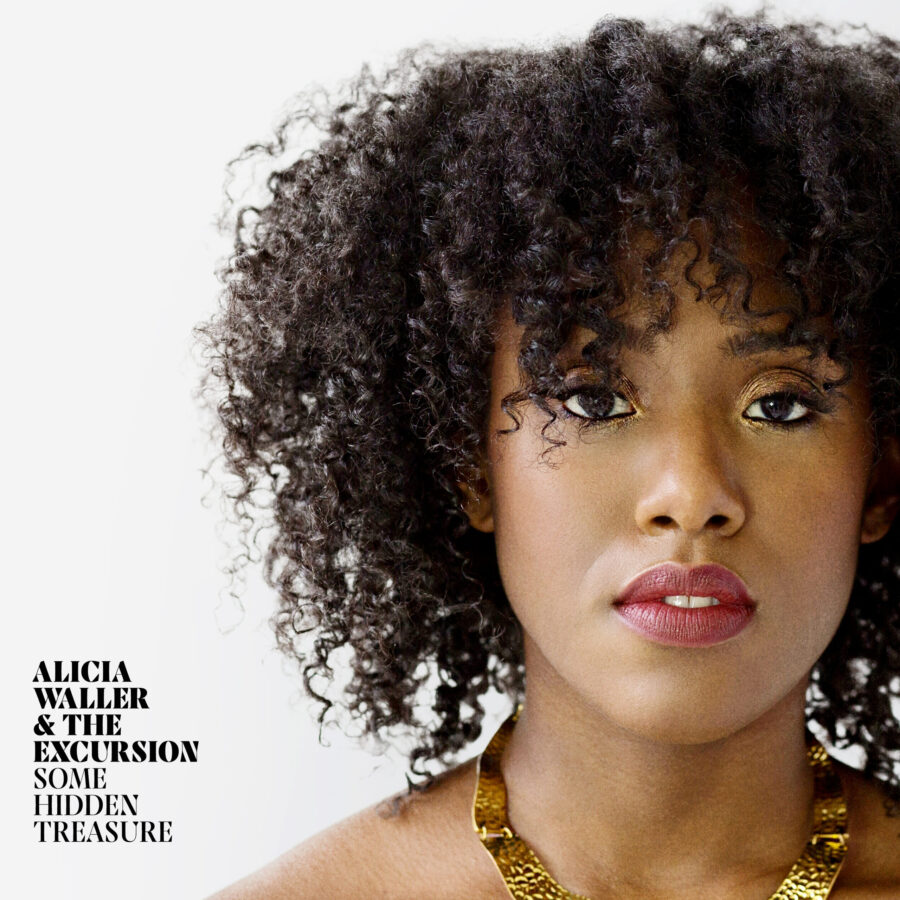
Alicia Waller is a New York City-based soprano, vocalist, and songwriter seeking to integrate a range of diverse musical traditions through a performance practice that centers around the female voice. To hear her is to encounter an incredibly versatile musician with a seemingly insatiable appetite for artistic exploration. She is, for example, a classically trained opera singer as well as an avid interpreter of a number of Latin and vernacular forms from around the world.
In her debut album release Some Hidden Treasure, Waller unveils four original songs that present a wide-ranging exploration of American music. Appearing as frontwoman of Alicia Waller & The Excursion, she calls the record “an experiment about the spaces in between.” Waller’s Some Hidden Treasure weaves globally inspired jazz with soul, soul with R&B, and R&B with spirituals and the blues, plus a nod to hip-hop. She achieves this all while expertly adapting her trained vocal instrument to an entirely new direction alongside veteran bassist and co-producer, Marcos Varela, and in the company of the formidable instrumentalists who form her backing ensemble, The Excursion.
While composing the E.P., Waller looked to the artists she’d grown up on—the music her parents listened to like Bobby Womack, Marvin Gaye, Donny Hathaway, and Anita Baker. Fascinated by the compositional complexity and textural diversity that these great musicians offered alongside their masterful vocal performances, she sought to develop a lush and varied sonic landscape for the album. The artist says that she wanted to push boundaries in contemporary music and challenge listeners. “When I went into this, I didn’t know exactly what was going to come out,” Waller states. “I just knew that I wanted it to sound ballsy and new. I wanted the voice to have a touch of classical and jazz, but the instrumentation to feel like soul music. I wanted it to sound like it came from the gut.”
The record is also a frank expression of feminine vulnerability. In the frenetic “Soul,” Waller and the band race between three distinct musical themes as the singer describes her contradictory emotions toward a lover—courting him, refusing him, and seducing him at once. In the title track, “Some Hidden Treasure,” she tenderly contends with having fallen in love with a dear friend, while in “Just Step Back” she manically consults the many voices in her head as she frees herself from a relationship that has run its course. The song, “Clouds,” finds the singer at perhaps her most transparent, as she openly discusses a desire for love and fear of time lost.
Some Hidden Treasure is the opening act of an artist with a lot to say, and who is daring enough to say it all while channeling her musical roots in a refreshingly inventive way.
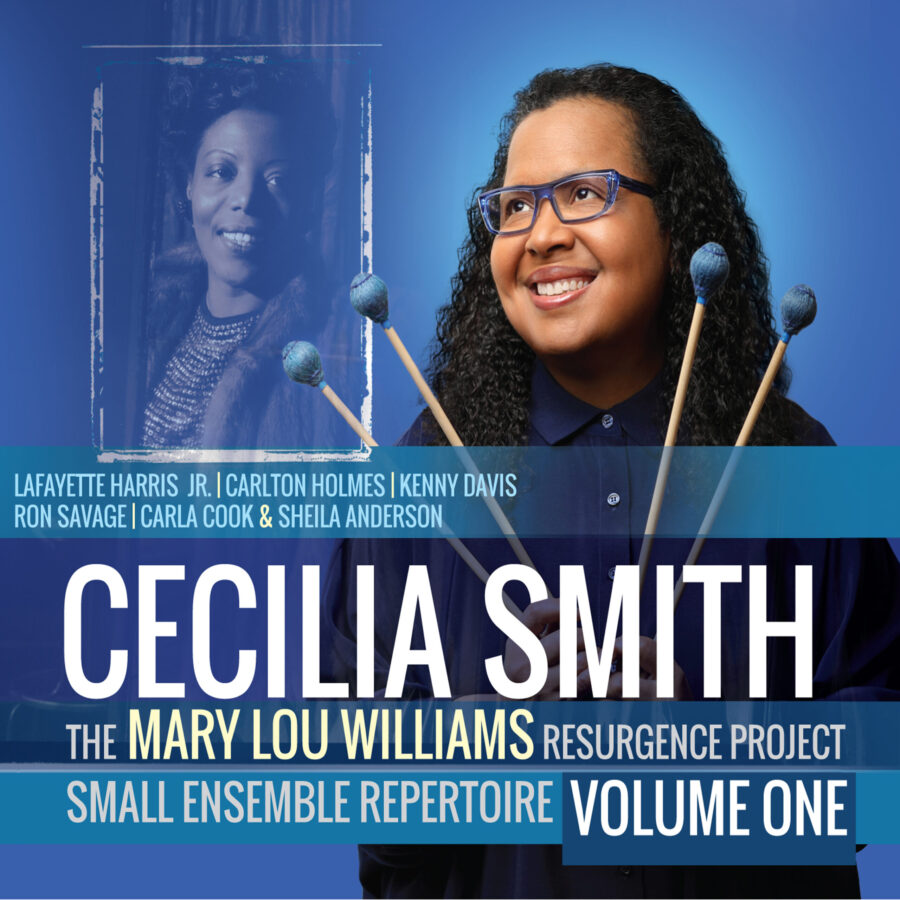
Building on a long track record of scholarship and interpretive artistry focused on the great Mary Lou Williams, vibraphonist and composer Cecilia Smith is proud to announce the release of Volume 1: Small Ensemble Repertoire, the new album from her NEA American Masterpiece Award-winning Mary Lou Williams Resurgence Project. Through countless hours of immersion in the Williams archive at the Institute for Jazz Studies, and direct access to manuscripts and scores from Williams’ former manager Father Peter O’Brien, Smith and her top-tier bandmates put their unique stamp on music either composed by Williams, composed in honor of her, or arranged and recorded by Williams during her lifetime. Among the timeless gems on Volume 1: Small Ensemble Repertoire is Williams’ previously unrecorded “Tell Me How Long the Train’s Been Gone,” sung by the acclaimed Carla Cook.
Pianist and composer Mary Lou Williams made her reputation as a road warrior with the storied Midwestern territory bands of the 1930s (notably Andy Kirk’s 12 Clouds of Joy). She gained renown as a formidable boogie-woogie pianist, but her pioneering role in Swing Era big band arranging and composition was for far too long unheralded. She also served as a mentor to Thelonious Monk, Bud Powell and other icons of the bebop revolution, and continued to refine and deepen her creative vision until her death in 1981. In Smith’s treatments we hear the intelligence and inventiveness that Williams brought to all her endeavors. With her seasoned swing feel and sparkling touch on the vibes, Smith finds a solid rapport with longtime colleagues Lafayette Harris, Jr. and Carlton Holmes (sharing piano and Hammond organ duties), bassist Kenny Davis and drummer Ron Savage. The album is coproduced by Smith, Harris, Jr. and master trumpeter and educator Cecil Bridgewater.
On Volume 1: Small Ensemble Repertoire, Smith extends her considerable performance history with Mary Lou Williams’ music, bringing new insights and ideas to the work at every opportunity. She leads off with her original “Sketch One — Truth Be Told,” incorporating a sequence of motifs drawn from Mary Lou’s pieces “Nicole,” “Waltz Boogie” and “Truth” (a.k.a. “Scratchin’ in the Gravel”). The fourth and final motif, commonly identified with Thelonious Monk’s “Rhythm-a-ning,” is in fact a riff from the killer shout chorus in Mary Lou’s “Walkin’ and Swingin’” (1936) — just one of Williams’ innovative contributions to the band book of Andy Kirk’s 12 Clouds of Joy. “Sketch Three — 100 Years of Mary Lou Williams,” a Smith original in . time, is another fine example of elevated swing and flowing lyricism. “I’ve combined a gospel feel with unique harmony and a simple melody,” the composer remarks. “My mission is to keep Mary Lou’s music current and in the world as part of the jazz narrative.”
Cecilia Smith is a leading vibraphonist of the four-mallet technique and an avid composer and arranger, with six albums as a leader to her credit. She has recorded and performed with Gary Bartz, Milt Hinton, Randy Weston, Marian McPartland, Donald Harrison, Greg Osby, Billy Pierce, Mulgrew Miller and Cecil Bridgewater. Her vibraphone stylings can be heard on Cassandra Wilson’s acclaimed Traveling Miles, Digable Planets’ Blowout Comb, Lonnie Plaxico’s Short Takes and more. She received a Joyce Foundation Award to develop her multimedia work Crossing Bridges. Another multimedia work in development, Decisive Moments, is being made in collaboration with Blue Man Group video artist and filmmaker Kevin Frech. Smith is a 2016 recipient of the Ziegfeld Club’s Elizabeth Swados Award. She is the Artistic Director of the Mary Lou Williams Resurgence Project and a teaching artist for nonprofit organizations and social service agencies.